
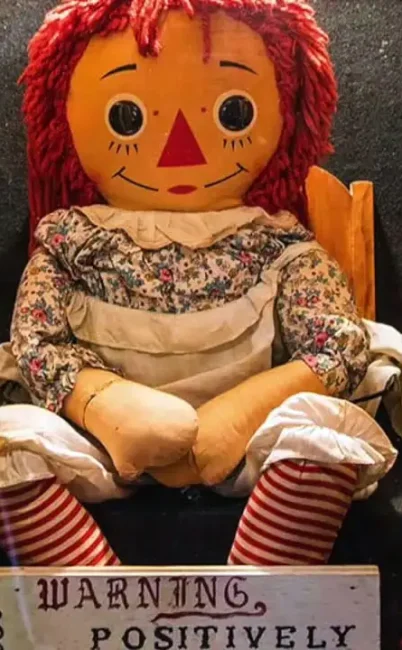
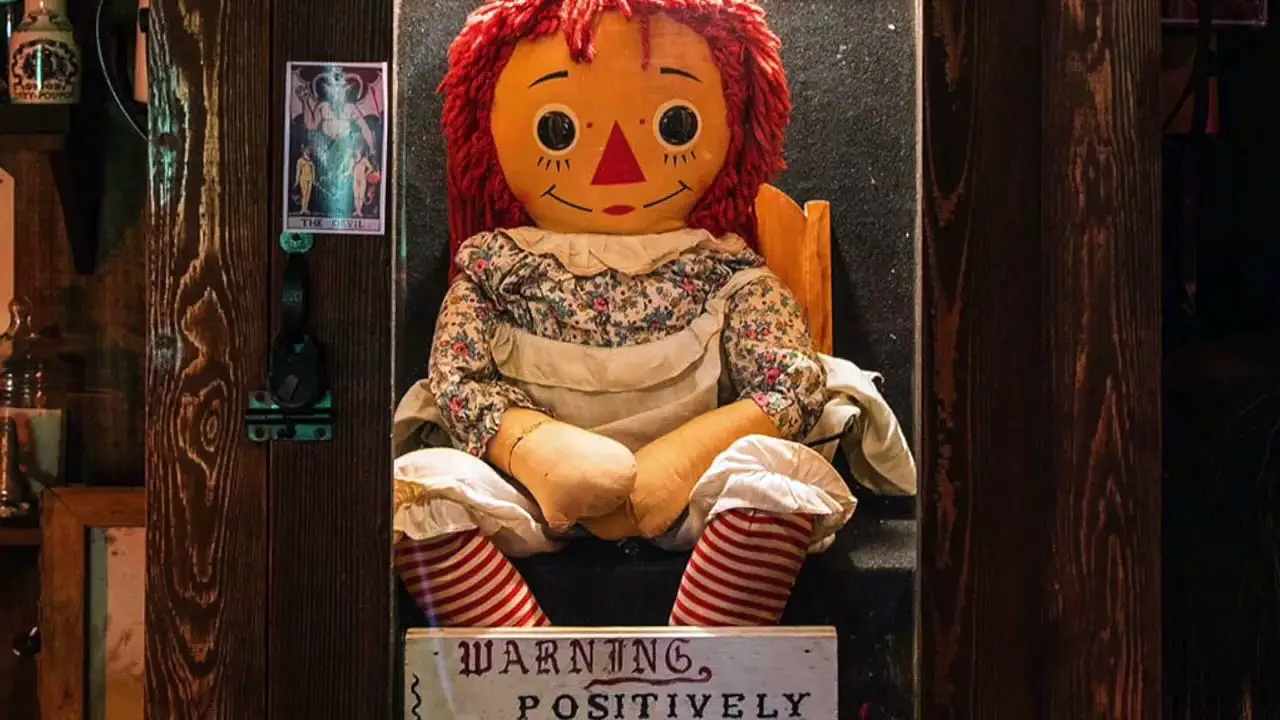
 Few objects in modern paranormal lore have achieved the notoriety of the Annabelle doll. Encased behind glass, adorned with warning signs, and promoted as “demonically possessed,” Annabelle has become a cultural icon of fear. Through books, lectures, and blockbuster films, Ed and Lorraine Warren transformed an ordinary children’s toy into one of the most infamous haunted objects in the world.
Yet when the story is examined beyond its theatrical retellings, the Annabelle case reveals itself not as a genuine haunting—but as a carefully constructed narrative, built on unverifiable claims, contradictions, and commercial opportunity.
The Doll Behind the Legend
The first truth rarely emphasised in popular media is deceptively simple: Annabelle is not a porcelain horror doll.
She is a Raggedy Ann doll—a soft, cloth children’s toy mass-produced throughout the 20th century. She cannot stand independently. She cannot grip objects. She cannot change facial expressions. She lacks joints, rigidity, and any structural capacity to perform the actions attributed to her.
And yet, according to the Warrens’ account, this doll:
- Moved independently around an apartment
- Changed physical locations repeatedly
- Left handwritten messages
- Displayed violent intent
- Caused physical injury
From the outset, the claims defy not only scepticism, but also fundamental physics.
A Story Told Only One Way
The Annabelle case originated in the early 1970s and allegedly involved two young nurses who reported strange occurrences associated with the doll. But critical details are conspicuously absent.
There are:
- No police reports
- No medical records
- No dated photographs
- No contemporaneous documentation
- No independent witnesses
The nurses themselves never became public advocates for the story, nor did they provide written testimony that can be independently examined. Instead, the case exists almost entirely through retellings by the Warrens, often decades after the events supposedly occurred.
This is a hallmark of manufactured hauntings: the narrative is controlled by those who profit from it.
The Notes That Shouldn’t Exist
One of the most repeated elements of the Annabelle story involves handwritten notes allegedly left by the doll, containing phrases such as “Help Us” or “Miss Me?”
However, the evidence supporting this claim collapses under scrutiny.
The notes were said to have been written on parchment—a material not owned by the apartment’s occupants. No explanation was ever provided for how the doll obtained it. No samples were preserved. No photographs were taken at the time. No handwriting analysis was performed.
In short, the notes exist only as a story. One that conveniently heightens fear while leaving no trace behind.
From Harmless Spirit to Demonic Threat
Initially, the Warrens’ account describes the doll as being inhabited by the spirit of a deceased child named Annabelle Higgins. A medium allegedly conveyed that the spirit meant no harm and only wished to be loved. The Warrens themselves later rejected this explanation.
Instead, the narrative shifted dramatically: Annabelle was no longer a child’s ghost but a demonic entity feigning innocence to gain attachment and possession. This shift is crucial because it reframes the story from a benign haunting into a dangerous case requiring religious authority.
The contradiction is telling. When the medium’s message conflicted with the Warrens’ demonological worldview, and their public brand, it was discarded.
The Illusion of Church Authority
The Warrens frequently implied that the Catholic Church endorsed their actions, lending the Annabelle case a sense of official legitimacy.
In reality:
- The Church has never formally recognised the Annabelle case
- No documentation of a sanctioned exorcism exists
- Clergy involvement appears informal and anecdotal
- Despite this, references to priests and blessings became central to the story, reinforcing its perceived authenticity while avoiding verifiable confirmation.You sent
The Warrens Pattern
Annabelle does not exist in isolation. It follows a pattern seen repeatedly in cases promoted by the Warrens – most notably the Amityville Horror, which has been extensively debunked and admitted by participants to be largely fictional.
Common elements recur:
- Stories grow more dramatic over time
- Key details change between retellings
- Independent investigators are excluded
- Physical evidence is absent or “lost”
- Financial gain accompanies notoriety
- The Annabelle doll became a centrepiece attraction in the Warrens’ Occult Museum, drawing crowds, lecture fees, and eventually Hollywood contracts.
- Fear, after all, sells.
- Psychological Explanations Ignored
- Psychologists and sceptics have long suggested alternative explanations for the original experiences associated with the doll:
- Suggestibility and reinforcement
- Stress and anxiety among young adults living alone
- Confirmation bias
- Shared storytelling escalating into belief
- Rather than investigate these possibilities, the Warrens framed the case in absolute supernatural terms—dismissing any explanation that reduced the narrative’s impact.
The Birth of a Modern Urban Legend
Through repetition, selective storytelling, and cinematic adaptation, Annabelle crossed the threshold from anecdote to assumed truth. For many, the doll is now “known” to be possessed—not because of evidence, but because the story has been told so often.
Hollywood transformed a cloth doll into a monster. Marketing transformed rumour into lore. The museum display transformed suggestion into spectacle.
Conclusion: Fear in a Glass Case
When stripped of embellishment, the Annabelle case contains no proof of the paranormal. There are no documents, no recordings, no verifiable witnesses, and no physical evidence—only a narrative refined over decades.
Annabelle does not demonstrate the existence of demons.
She demonstrates how easily fear can be manufactured, monetised, and preserved—locked safely behind glass, where questions are discouraged, and belief is encouraged.
The real haunting is not the doll itself, but the story we were told to believe.
