
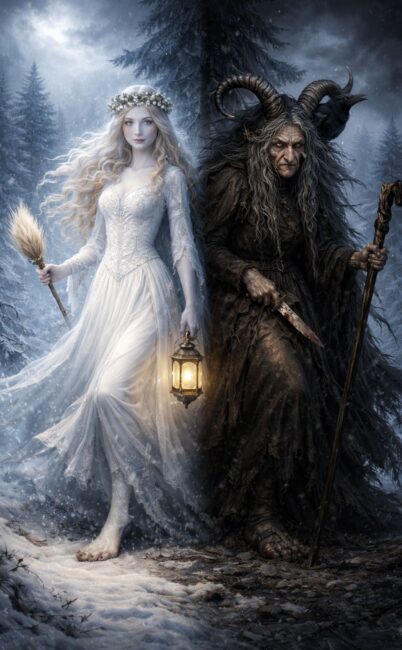
We’re getting closer to the end of the Christmas Creature Countdown, with only tonight and tomorrow left to go.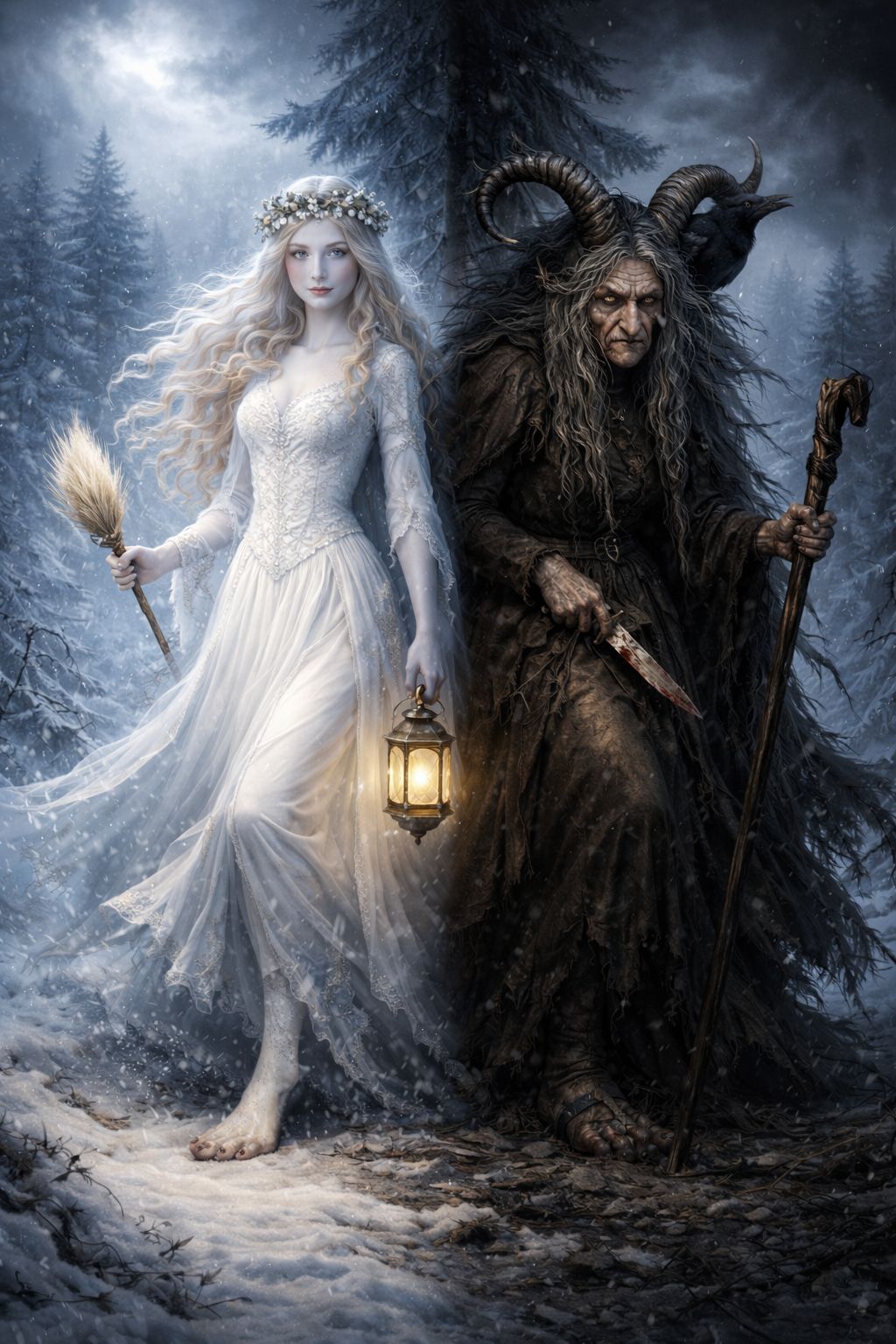 Tonight, we have “Frau Perchta, who is at times referred to as a companion or counterpart to Krampus.
Frau Perchta was regarded as a goddess in Alpine paganism across the Upper German, Austrian, and Slovenian regions of the Alps. Her name may mean ‘the bright one’ or ‘the bearer’ (Old High German: beraht, bereht, from Proto-Germanic *berhtaz) and is probably related to the name Berchtentag, meaning ‘the feast of the Epiphany’. Eugen Mogk proposes an alternative etymology, attributing the name Perchta to the Old High German verb pergan, meaning ‘hidden’ or ‘covered’.
She is often identified as stemming from the same Germanic goddess as Holda and other female figures of Germanic folklore. In other origins, Perchta is described as Holda’s direct southern cousin or equivalent, as they both share the role of “guardian of the beasts” and appear during the Twelve Days of Christmas, when they oversee textile spinning.
Perchta is said to have two forms: she may appear either as beautiful and white as snow, as her name suggests, or as elderly and haggard.
In many earlier descriptions, Perchta had one large foot (in both beautiful and haggard forms), sometimes called a goose foot or a swan foot. Possibly symbolising her being a higher being who could shapeshift to animal form. He noticed that Bertha with a strange foot exists in many languages (Middle German “Berhte mit dem fuoze”, French “Berthe au grand pied”, Latin “Berhta cum magno pede”, Italian ” Berta dai gran piè”, title of a medieval epic poem of Italian area): “It is apparently a swan maiden’s foot, which as a mark of her higher nature she cannot lay aside…and at the same time the spinning-woman’s splayfoot that worked the treadle”.
In some regions Frau Perchta is known to be accompanied by Straggele whom much like Krampus are described as demonic, beastly figures from Alpine folklore, companions to the pagan goddess Frau Perchta who haunt homes during the 12 days of Christmas to punish the lazy and bad children, feasting on leftovers left out for them but threatening to rob or tear apart kids if food isn’t provided. They are hairy, horned, and often depicted with protruding teeth, serving as Perchta’s terrifying helpers.
Initially, Perchta was the upholder of cultural taboos, such as the prohibition against spinning on holidays. In the folklore of Bavaria and Austria, Perchta was said to roam the countryside at midwinter, and to enter homes during the twelve days between Christmas and Epiphany (especially on the Twelfth Night). She would know whether the children and young servants of the household had behaved well and worked hard all year. If they had, they might find a small silver coin the next day, in a shoe or pail. If they had not, she would slit their bellies open, remove their stomach and guts, and stuff the hole with straw and pebbles. She was particularly concerned to see that girls had spun the entire allotted portion of flax or wool during the year. She would also slit people’s bellies open and stuff them with straw if they ate something on the night of her feast day, other than the traditional meal of fish and gruel.
In contemporary culture, Perchta is portrayed as a “rewarder of the generous, and the punisher of the bad, particularly lying children”. Today in Austria, particularly Salzburg, where she is said to wander through Hohensalzburg Castle in the dead of night.
In the Pongau region of Austria large processions of Schönperchten (“beautiful Perchten”) and Schiachperchten (“ugly Perchten”) are held every winter. Beautiful masks are said to encouraging financial windfalls, and the ugly masks are worn to drive away evil spirits.
So let that be a lesson to you – tidy up after Christmas or Frau Perchta will split your belly and fill it with all of your left over rubbish.
-Sam 
