
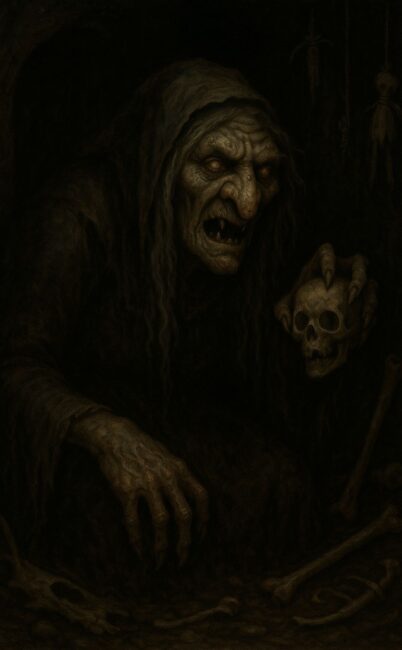
Today, in our Christmas countdown of monstrous Christmas creatures from around the world, we have yet another from Iceland, “Grýla”.
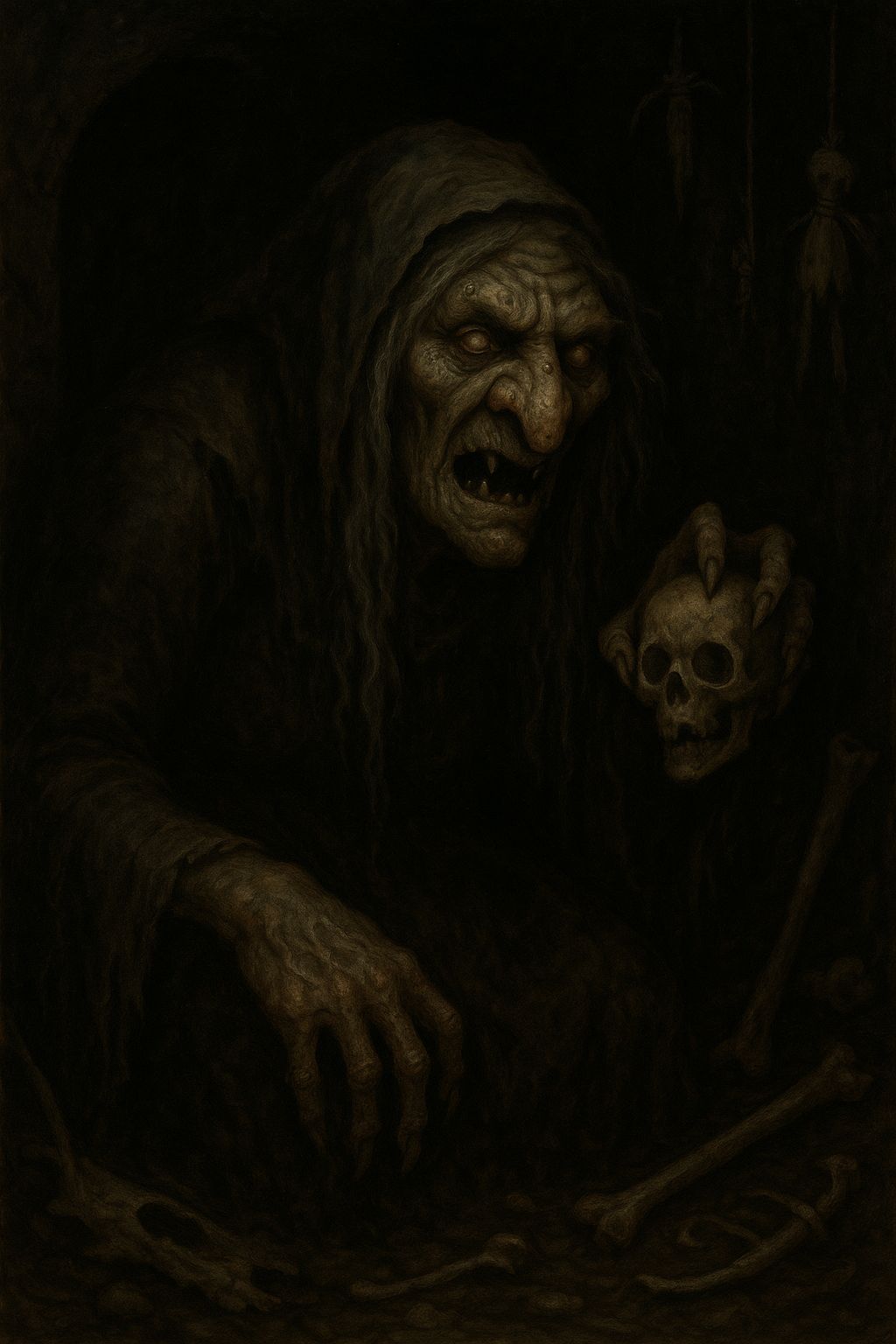 Grýla (roughly translating to “growler”
  ) lives further north, in the frigid climes of Iceland. She is often depicted as a witch-like ogre with up to five-horned tails and carrying a sack to kidnap naughty children. She is said to live in a cave in Iceland’s hinterlands. She is the matriarch of a family of strange creatures, launching attacks on nearby townships, snatching up misbehaving children, and turning them into delicious stew.
Tales of the ogre began as oral accounts, with the earliest written references dating to the 13th century, in historic sagas and poems throughout the region. One reads, “Here comes Grýla, down in the field, / with fifteen tails on her,” while another describes, “Down comes Grýla from the outer fields / With forty tails / A bag on her back, a sword/knife in her hand, / Coming to carve out the stomachs of the children / Who cry for meat during Lent.
Grýla did not become associated with Christmas until around the early 19th century, when poems began to link her to the holiday. It was also about this time when the Yule Lads and Yule Cat—which had been standalone Christmas characters with no connection to the Christmas witch—then became part of her big, creepy family. Before Christmas traditions, she was seen as a personification of winter and the darkness and the snow getting closer and taking over the land. Icelandic people understood themselves to be more like tenants of their harsh environment (where glaciers, volcanoes, and earthquakes dominate). They would view mythical creatures like Grýla as the ones who were really running the show.
As of the 19th and 20th centuries, Grýla (in terms of Christmas tradition) has become more child-friendly in both appearance and origin story – especially when child kidnapping and consuming is involved. Despite this, the Icelandic National Museum continues to attempt to “de-Santafy” Grýla and return her to her original monstrous form.
-Sam 
